
Introduction
Have you encountered a situation where the dimensions marked on the outer packaging of your purchased air filter do not match the actual dimensions? Commonly used industrial air filters, if the size is selected incorrectly, may lead to difficult installation, edge bypass, substandard filtration efficiency, and finally increase energy consumption of HVAC systems. Faced with the diverse length, width and thickness specifications on the market, how can you quickly find the suitable model? This article will focus on standard air filter sizes to help you reduce selection and purchasing mistakes.
What is a standard air filter size?
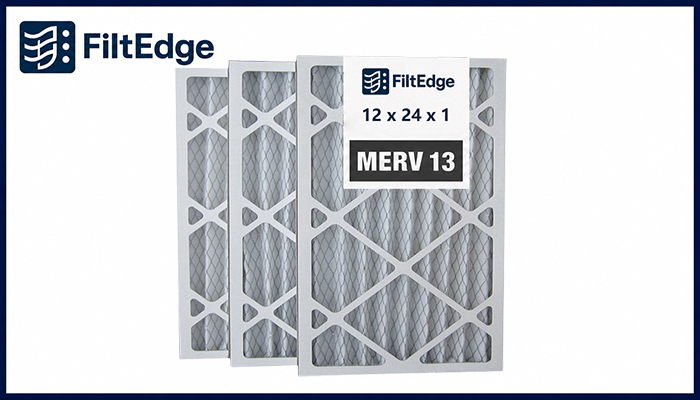
Standard air filter size refers to the air filters that are more common models and can fit most HVAC systems and air conditioning equipment. It is not a separate size, but a specification with specific dimensions, usually expressed by “length × width × thickness”. For example, 20×20×1 in.
What are the standard air filter sizes?
Standard sizes commonly available in the US market include:
- 16×20×1 in.
- 16×25×1 in.
- 20×20×1 in.
- 20×25×1 in.
- 14×20×1 in.
- 14×25×1 in.
- 12×24×1 in.
- 24×24×1 in.
In addition to 1-inch thickness air filters, some HVAC systems typically still use 2-inch, 4-inch, 5-inch, 6-inch thickness air filtration. The thickness can be selected according to your needs, and the thicker one needs more space, accommodates more filter materials, and has a larger filter area. However, its usability still depends on the size of the mounting slot of the device.
What is the difference between nominal and actual dimensions?
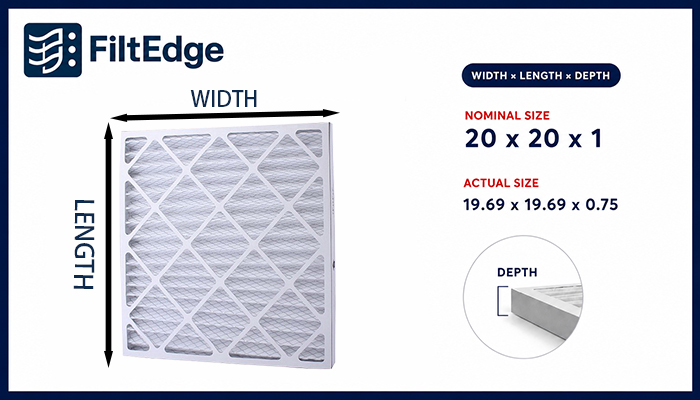
The ruler is to facilitate product dimensioning, classification and ordering. It is generally represented by an integer. For example, 16×20×2 inches is its nominal size.
The actual size is the real size obtained after measuring the outer frame of the filter with a tape measure. Usually, in order to reserve a certain space for installation, the actual size is usually slightly smaller than the nominal size. This deliberate error is actually to facilitate the installation and disassembly of the air filter, do not need to be forcibly squeezed, and avoid the deformation and damage of the air filter frame.
The nominal size is mainly convenient for product classification and customer search. The actual size is to determine whether the air filter can be installed in the equipment. Even if the nominal size marked by different manufacturers in the market is the same, the actual size will be different. Therefore, when purchasing an air filter, be sure to measure the true size of the filter installation slot, so as to avoid the fact that the size is too large to install, or the edge gap is too large to cause air leakage.
Why do air filter sizes have to be accurate?
Air filter is a line of defense of HVAC system, which can effectively intercept dust, batting, pollen, bacteria and other pollutants, avoid pollutants circulating indoors, and prevent impurities from accumulating and damaging equipment.
What are the problems associated with an improper air filter size:
- Loose filter or unstable installation
- Air leakage at the edge, air directly through the screen
- Generate abnormal movements and noise
- Substandard filtration efficiency
- Unable to install into device
- Frame deformation caused by forced installation
- Damage to filter material or sealing structure
- Difficulty in subsequent disassembly
- Installation door does not close
- Gasket fails to fit
- Interference post-stage air filter
- Increased dust collection inside HVAC
- Increased system resistance increased energy consumption
- Increased frequency of filter and equipment maintenance
- Increased frequency of air filtration and equipment maintenance
The larger the size of the air filter, the better, and it can’t be forcibly installed. If the size is large, the filter can’t be put into the installation slot. If the size is too small, it is easy to leave gaps around the frame. A suitable filter should be put into the installation slot smoothly, without obvious gaps around it, and the frame will not be deformed because of too tight.
How to properly determine and measure air filter size?
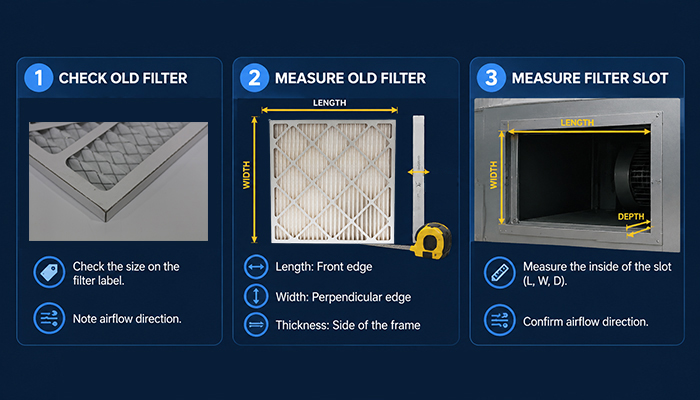
Method 1: If you have an old air filter, you can check the size label on the border. Most labels will show the length, width and thickness of the filter, the installation direction, and some will also mark the nominal size and actual size
Method 2: Take out the old air filter and measure it in turn with a tape measure
Length: Measure one edge on the front of the filter
Width: Measure an edge perpendicular to the front
Thickness: Measure the thickness of the side border of the filter
Record the exact value when measuring, and do not purchase the actual size directly. For example, when the measurement results are 19.5×19.5×0.75 inches, the corresponding nominal size is usually 20×20×1 inch
Method 3: If the old air filter has been lost, after turning off the HVAC unit, measure the length, width, and depth inside the filter mounting slot, while also confirming the direction of airflow, the arrow on the filter bezel usually towards the fan or internal equipment.
Tip: Be sure to measure the inner diameter of the card slot. If the air filter has been deformed, there are errors in the measured data, and it is easy to choose the wrong size.
What If You Need a Custom Air Filter Size?
Generally, old HVAC air filter units, non-standard air treatment equipment and special industrial filtration systems often use filters with different specifications than the conventional market specifications. If the standard size air filter size does not match your equipment, you can choose a custom size air filter
Before customization, the length, width and depth of the mounting slot need to be measured,
The information you need to provide is:
- Actual size of air filter
- Filter style and grade
- Volume of filtered air required
- Frame Material and Sealing Method
- Operating temperature and service environment
- Equipment model of HVAV
- Initial resistance requirements
Customized industrial air filter can not only choose size, but also choose frame, generally paper frame, galvanized frame, aluminum alloy frame, stainless steel frame or plastic frame, and can match filter material, filtration grade, gasket and support structure for you according to your working conditions.
If the frame needs special mounting holes, sealing grooves or connecting parts, you can meet your special needs through CNC machining, cutting, bending, stamping, welding, etc., and better fit your equipment
The Three Most Common Size Myths When Buying an Air Filter
Order by actual size, not nominal size
The industrial air filters sold on the market are marked with nominal sizes. It is difficult to find a matching product size by searching and buying according to the actual measured size.
It is easy to neglect the air filter thickness
The 25×25×1 inch and 25×25×2 inch screens have the same length and width, but are completely different in thickness, which makes it impossible to install or close the ventilation box cover smoothly.
Measure the dimensions of deformed old air filters
Using the deformed air filter, the border is bent and deformed, which is no longer consistent with the actual size, and the general data deviates greatly.
Conclusion
Whether you need to replace HVAC replacement air filter, or industrial equipment uses non-standard air filter, you can try to communicate with the engineers of FiltEdeg Air Filter Manufacturer, we provide standard size and custom size air filters, or you can customize the filter size, filter material, filtration grade, frame and seal structure according to your drawings combined with your actual working conditions. We can match you with the right products to help your business reduce energy consumption and operating costs.