Introduction of HEPA Air Filters: The Ultimate Guide to High-Efficiency Air Filtration
HEPA Air Filters are widely used in industrial and commercial buildings, semiconductor cleanrooms, pharmaceutical factories, etc., but in practice, airflow decreases, energy consumption increases, and the so-called “pseudo HEPA” products have non-transparent parameters, unclear standards, etc. This guide will help you understand the working principle of HEPA Air Filters, their classification, common usage pain points, purchase mistakes, and maintenance. This guide will take you to understand the working principle, classification, common use of HEPA Air Filters, purchase mistakes and maintenance methods.
What is a HEPA Air Filter?
According to the international definition, a true HEPA Air Filter is able to filter 99.97% of particles with a diameter of 3 microns. It is generally made of tightly interwoven glass fibers and synthetic fibers and other materials, through a multi-layer fiber structure to intercept and capture small particles in the air. HEPA Air Filters can not only effectively capture particles with a diameter of about 0.3 microns, but also for larger or smaller particles, through diffusion, interception and inertial collision and other roles to achieve high efficiency filtration.
What is The Working Principle of HEPA Air Filter?
The working principle of HEPA Air Filter:
As the filtered air passes through the dense fiber mesh, multiple filtration mechanisms intercept the particulate matter, which then adheres to the filter fibers.
Interception Effect
Larger particles are directly intercepted as they pass through the fibers.
Inertial Impact
particles moving at high speeds have no time to change their direction of motion and will directly impact on the fibers.
Diffusion Effect
very small particles will produce Brownian motion, the motion state is not stable, easy to adsorb to the fiber surface.
Gravitational Settling
Heavier particles will slowly settle on the fibers as they pass through the filter.
Types of High Efficiency Particulate Air Filters
HEPA Air Filters are not classified according to the filtration level, but according to the structural design, sealing method and applicable scenarios.
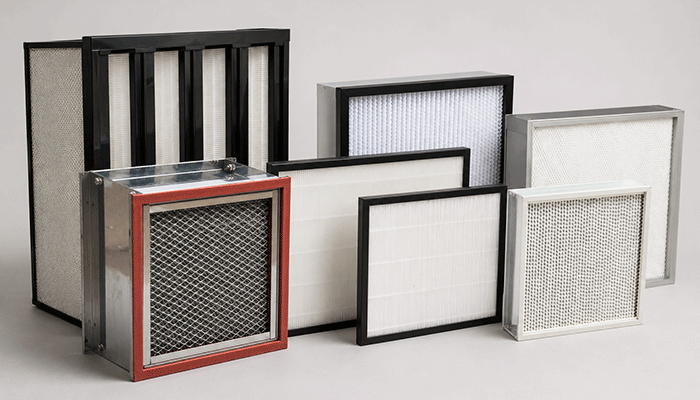
Plate-type High-efficiency Particulate Air Filter
The structure of this type of filter is generally simpler, and it is suitable for basic filtration at the end of HVAC. The product price is low, but the wind resistance is large.
W/V type High-efficiency Particulate Air Filters
These filters have sufficient airflow, large filtering area and low wind resistance, and are mostly used in industrial HVAC systems.
Box-type High-efficiency Particulate Air Filter
Equipped with a metal frame, it can be directly installed as the end filtration device, with good sealing performance, and is commonly used in clean rooms, pharmaceutical workshops and dust-free workshops.
Liquid Tank Sealed HEPA Air Filter
It adopts gel sealing structure to prevent side air leakage, and is mainly used in semiconductor factories and high-standard cleanrooms.
High-temperature-resistant HEPA Air Filter
Made of metal frame or special glass fiber, suitable for high-temperature exhaust system, with high wind resistance and higher cost.
Practical Application of HEPA Air Filter High Efficiency Air Filter
HEPA Air Filter high-efficiency air filters are widely used in a number of fields with high requirements for air cleanliness, specifically including:
Medical and health field: commonly used in hospital operating rooms, isolation wards, ICUs and laboratory environments for filtering airborne bacteria, virus carrier particles and harmful particles.
Industrial manufacturing: used in semiconductor,, electronics, precision instruments and other production environments for controlling dust and particle pollution;
In commercial and office buildings, commonly used in central air conditioning system HVAC and air purification equipment;
In transportation and public space, such as airplanes, subways, high-speed railways and airports and other confined or crowded environments, high-efficiency air filter systems are also used to improve air safety.
What are the Common Usage Pain Points of HEPA Air Filter?
Common usage pain points, insufficient CADR/airflow, high resistance, large filtration area, high cost of consumables, maintenance frequency, poor sealing, and insufficient coverage of complex pollutants.
Decreased Airflow and Insufficient CADR
Numerous equipments after using HEPA Air Filter, there will be air volume attenuation obviously, CADR (clean air output rate) is not up to standard. In the scene of relatively large air exchange volume, it is easy to lead to a decline in air circulation efficiency.
High Resistance and Increased Energy Consumption
The higher the filtration precision of HEPA Air Filter, the higher the resistance will be, allowing long-term environment, the burden of the fan will be aggravated, the energy consumption will increase, and finally will affect the life of the equipment.
Conflict Between Filtration Area and Filtration Space
In order to reduce the resistance, generally need a larger filtration area, which needs to increase the volume of equipment, in the space limitations of the place, will form a design conflict.
High Cost of Consumables
HEPA Air Filter material is generally used glass fiber, can not be repeated cleaning and use, when the high-efficiency air filters form a blockage, can only replace the filter material, especially in the high dust and high load environment, the replacement cycle is even shorter, the cost is significantly higher.
Poor Sealing Leads to Bypass Risk
If the sealing structure and sealing design is not perfect, there will be a small bypass leakage, even if the efficiency of the filter media itself is very high, it will lead to the overall purification effect is not up to expectation.
How to Choose the Right HEPA Air Filter for Your Facility?
Which HEPA Air Filter to choose for your facility usually depends on the cleanliness requirements of the facility, particle size, airflow/pressure drop, maintenance cost, etc. If the facility is a commercial facility, the highest level of filters is not required, if it is a semiconductor facility, laboratory, cleanroom, then the higher level of HEPA Air Filter or even ULPA, will be required.
Workshop Dust
In sanding, carpentry, 3D printing, maintenance workstations, meet more air extraction effect is not so good, the machine is relatively large, high filter resistance, filter area is not enough, the air circulation speed is very slow. This type of problem is not a component can be solved, the need for optimization from the whole, the need to increase the effective filtration area to reduce the unit load, the choice of low-resistance anti-clogging filter structure to enhance its stability. Combined with the real working conditions of pressure loss to match the fan curve, to ensure that in the high resistance state can still maintain the effective air output, only system matching, in order to truly realize, stable, continuous, low attenuation of the dust quality effect.
Welding and Fume
In welding, cutting and metalworking scenarios, equipment is very effective at capturing particulate matter, but cannot completely remove fumes and odors. There is no way to solve this problem at its root if you rely solely on HEPA AIR FILTER systems. Firstly, it is necessary to control the welding fume at the source, to capture the welding fume as close as possible to the point of generation, to reduce the scope of diffusion, secondly, to use high efficiency filtration systems, such as multi-layer pre-filter and HEPA AIR FILTER, in the particle processing stage, to ensure that the welding fume particles are captured stably and to prolong the life of the filtering material. Third, add activated carbon or chemical adsorption module in odor and gaseous pollutant treatment to provide secondary treatment for fumes and odors, to compensate for the effect that HEPA AIR FILTER cannot achieve.
Cleanroom and Laboratory Environments
In the semiconductor, laboratory, medical auxiliary clean environment, although the HEPA Air Filter cleanliness is relatively high, but the air volume decreases very quickly, clean air output and enough circulating air volume is difficult to coexist. I have encountered more customers, in order to increase the cleanliness of the output air, by increasing the resistance, at the expense of the frequency of air exchange, can not achieve the filtration effect. To solve this problem completely, we need to upgrade from single filtration to clean air circulation system design, which can effectively ensure the stable output of high-grade filtration efficiency and reduce the pressure loss at the same time.
Option and Maintenance Guide
Option Misconceptions
Many users will take the HEPA Air Filter level as the core index, but in reality, what really affects the field experience is CADR, airflow, noise and adaptable space. So the core of choosing HEPA Air Filter, first look at the adaptable scene, then look at the filtration level and airflow, and finally need to rely on standardized maintenance to extend the life of HEPA Air Filter.
Points for selection
First of all, in theory, qualified HEPA Air Filter can filter at least 99.97% of 0.3 micron particles.
Depends on the use of the scene
Need to pay attention to the CADR and room area matching, the larger the room, the higher the CADR needed, and the ceiling is too high, should choose a higher CADR models
According to the pollutant judgment
HEPA Air Filter mainly for particles, the effect is more obvious, if you need in addition to the odor or VOC, relying on HEPA Air Filter is not enough need to cooperate with the activated carbon air filter module.
Look at the noise and wind speed
The higher the wind speed, the more air filtration, the noise may also be greater, if you need low noise, you need to choose low noise and can run in a low-speed filter.
Compatibility
For HVAC/central air conditioning, choose the highest possible rating within the range that the system can withstand.
Conclusion
Overall speaking, HEPA AIR Filter can not filter everything, in Filtedeg high-efficiency air filtration to intercept particulate matter technology is more mature, for the need to improve environmental quality, filter particulate matter, HEPA AIR Filter is still a very ideal choice. If you need to remove odors and vapors, you still need activated carbon air filtration, and to achieve the desired filtration effect, you need to consider various aspects.