
Introduction
Compared with filter bags, the importance of the filter cage in dust collection systems is often given less attention.But in fact,many problems that occur during the operation of filtration equipment, such as abnormally high pressure drop, decreased cleaning efficiency, and premature filter bag damage, are closely related to the design and quality of the cage.Without understanding the function and working environment of the cage, it is easy to overlook potential problems during selection or maintenance.
This blog will show you the function, design, selection points, applications, and common problems of cages, in order to help you optimize the overall operation of your dust collection system.
The Necessities of Filter Bag Cage
A filter bag cage is a supporting framework installed inside the filter bag in a dust collection system. It is indispensable in pulse-jet dust collectors and in applications involving long filter bags (typically >2-3 meters), high airflow velocities, or high-humidity dust conditions. It doesn’t simply support the filter bag; it provides stable structural conditions for the filter bag during operation, thus ensuring the overall stability and filtration efficiency of the dust collector.
With the strong support provided by the filter cage, filter bag maintains its shape even under strong airflow impact, allowing the airflow to act uniformly on the bag surface and preventing stress concentration. This results in a series of practical benefits:
Preventing localized dust accumulation and improving cleaning efficiency;
Reducing localized wear on the filter bag and effectively extending its service life;
Maintaining smooth airflow channels and stable pressure differences, ensuring long-term stable operation of the dust collection efficiency.
A Right Filter Cage
Filter bag cages are available in various forms and materials. When choosing a cage, users need to consider the working conditions and comprehensively evaluate the design and details of the cage to select the most suitable one. That is because the right cage is precondition for achieving optimal performance and economic benefits.
The following are various selection points regarding cages, which you can refer to based on your actual needs.
Materials of Bage Cage
In the field of industrial dust collection, filter cages are commonly made from three types of materials: carbon steel (Q235), galvanized steel, and stainless steel. Each material exhibits different characteristics and are suitable for different working conditions.
| Material | Primary Features | Applicable Conditions |
| Carbon steel (Q235) | Relatively low cost | Normal temperature, dry, non-corrosive |
| Galvanized steel | Anti-rust | Lightly damp, general industrial dust |
| Stainless steel | Resistant to corrosion | High humidity, high corrosiveness, presence of acid/sulfur-containing dust conditions |
Surface Treatment of Filter Cage
Metal anti-corrosion treatments, such as electroplating and hot-dip galvanizing, can improve the cage’s corrosion resistance.
Organic coating treatments, such as silicone and epoxy coatings, can make the cage corrosion-resistant and rust-proof.
Cages treated with PTFE coating can be used in highly corrosive, anti-stick dust, and high-humidity conditions.
Applying anti-corrosion and coating treatments to the surface of filter cages is a common and cost-effective practice in industrial dust collection. Simple treatment of cost-effective base materials can impart additional performance characteristics to the cage and extend its service life.
For example, in high-dust environments such as cement plants, filter bag cages treated with electrogalvanizing show significantly less corrosion and better structural stability compared to ordinary carbon steel cages, effectively extending their service life while controlling costs.
Shape of Filter Bage Cage
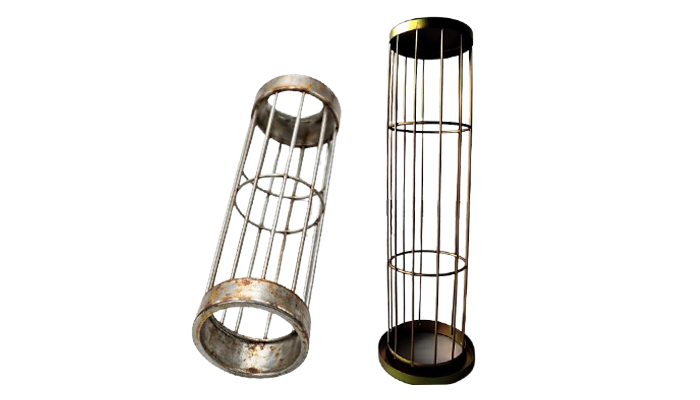
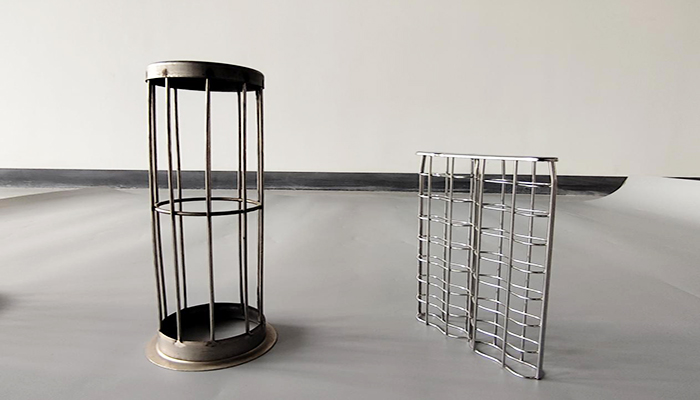
The Round Cage is the most commonly used cage for pulse jet baghouses with medium to high airflow conditions.
The reason this cage has become the most popular is that the round shape provides the most uniform force and thorough cleaning.
The FlatCage is used in Flat Baghouses or dust collectors where space is limited and is suitable for short bags and low to medium airflow dust collection systems.
The reason for the existence of this cage is that in some special designs, it can better match the space layout of the filter bag and the air duct.
Basic Structure of Baghouse Cage
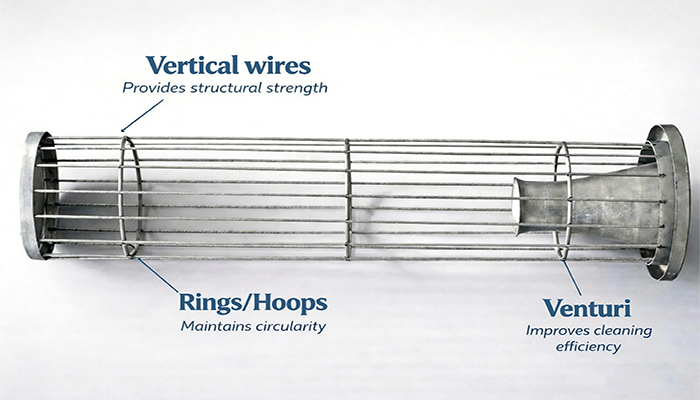
The vertical wires determine the support strength of the cage.
Generally, more vertical wires with a larger diameter provide stronger support, but wires that are too thick or too closely spaced can accelerate filter bag wear. Therefore, when selecting, it is necessary to choose the appropriate wire diameter and quantity based on actual working conditions.
The rings/hoops maintain the roundness of the cage and prevent deformation.
A filter cage with good roundness allows the filter bag to expand evenly and maintains the stability of the airflow channel.
The venturi helps to ensure more thorough cleaning.
You can decide whether to use a cage with a venturi based on the required cleaning efficiency.
Problems Arising from Poor Design and Workmanship
Poor design or workmanship can affect the normal functioning of the cage. I have compiled relevant information learned from actual cases, hoping it will be helpful to you.
Filter Bag Wear
If a cage with uneven distribution of vertical wires or large deviations in roundness (local inward or outward deviations) is used, the filter bag will be tightly pressed against the vertical wires in some areas, leading to localized wear and even premature bag rupture.
Incomplete Dust Cleaning
Insufficient precision of the molding die, failure to correct the roundness, or improper transportation and storage for extended periods can all lead to unqualified roundness of the cage.
A cage with poor roundness can cause some areas of the filter bag to be flattened or loosened, resulting in uneven airflow distribution on the filter bag surface, leading to uneven dust removal and reduced cleaning efficiency.
Low Pulse Efficiency
The main function of the Venturi is to concentrate and accelerate the cleaning airflow, allowing the airflow to act more evenly on the filter bag surface.
However, a poorly designed Venturi, such as an unreasonable throat angle, rough surface, or mismatch between the inner diameter and the blowing pipe, will cause the airflow to concentrate more on the upper part of the filter bag, leading to dust accumulation in the lower part and reducing the stability of the dust removal system.
Filter Bag Scratches
Burrs caused by poor workmanship are the most insidious source of damage to the filter bag. They may not be visible at first, but after a period of operation, they will severely damage the filter bag through friction. Therefore, the spot welding current needs to be controlled stably, and the cage must be carefully polished or buffed.
Conclusion
Filter bag cages are crucial in dust collection systems. Their design, material, and manufacturing quality directly impact the lifespan of the filter bags, the cleaning efficiency, and the overall dust collection efficiency. A thorough understanding of the cage is essential to maximize its performance and prevent problems such as localized wear on the filter bags, uneven cleaning, reduced pulse efficiency, and even filter bag rupture caused by improper cage design or manufacturing.
Choosing the right filter bag cage not only ensures the long-term stable operation of the dust collection system but also reduces maintenance costs and improves overall efficiency. If you are looking for high-quality cages that perfectly match your filter bags, please contact Filtedge. We provide professional advice and high-quality products to help your dust collection system achieve optimal performance.
FAQ
Q1. Why do filter bag cages fail prematurely?
There are many reasons for the failure of filter bag cages, the most common of which is corrosion.
In high-humidity or sulfur-containing flue gas conditions, once the temperature inside the dust collector drops below the dew point, water vapor will condense on the cage surface and absorb acidic components. This easily creates a localized, highly corrosive environment, leading to pitting corrosion of the filter cage and accelerating overall rusting.
In addition, several other factors can also affect the normal use of the cage.
Substandard surface treatment: Uneven coating thickness or poor adhesion will reduce the anti-rust, anti-corrosion, and anti-sticking effects, accelerating cage aging.
Welding quality problems: Unstable welds or micro-cracks may lead to cage deformation or fracture.
Mechanical fatigue: After long-term operation, especially for extra-long cages or those with insufficient longitudinal reinforcement, metal fatigue may occur, affecting the supporting force. Mismatched dimensions can cause abnormal contact between the filter bag and the cage, resulting in uneven stress on the cage, excessive pressure on certain areas, and accelerated wear.
Improper installation and maintenance: Bumping or rough handling during installation can also cause cage deformation or damage.
Q2.When can a dust filter bag be used without a bag cage?
- In the case of reverse air dust collectors and some pulse-jet dust collectors, a bag cage is generally not required.
The gentle cleaning method results in less instantaneous impact on the filter bags. In this case, the filter bags can usually maintain their shape relying on their own weight or external structure. - Using rigid or semi-rigid filter bag structures
- Flat bags inherently have a flat or rectangular structure, allowing for uniform airflow and minimal expansion, making them less prone to collapse. Therefore, they can maintain their shape with their own rigidity and external support frame.
- In experimental or small-scale dust collection systems under low temperature, low pressure difference, and low load conditions, filter bag cages can also be omitted.