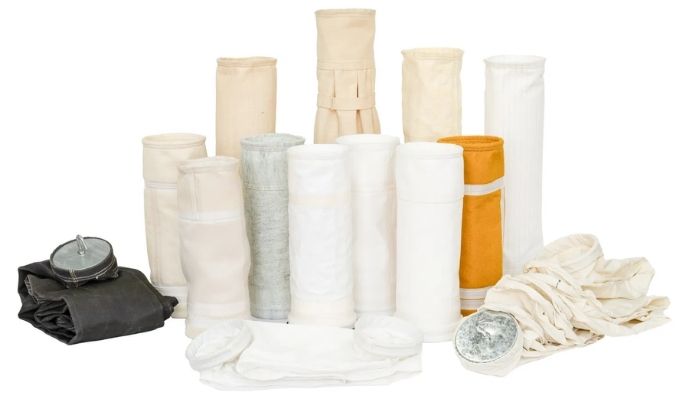
Bag Filter and Cartridge Filter are two commonly used and highly effective dust collection systems.
Many of our customers ask us when shopping for dust removal equipment, “Should I use a Bag Filter or a Cartridge Filter to ensure good operation?”
I realize that they don’t want to study dust removal theory. They just want to know which is better for their plant.
So let’s try to make it simple.
Quick Answer -About Baghouse and Cartridge Dust Collectors
Time is money. If you don’t want to read all the content, it will be equally helpful to read this section first.
You can give preference to a bag filter if the following conditions are met.
You are dealing with heavier and coarser dusts.
You are brave enough to have a high dust load.
You have sufficient space for the installation and operation of dust removal equipment.
You may prefer a cartridge dust collector.
You want to handle finer dusts.
You have limited space for the dust collector, or you want to save space.
You have strict emission standards.
You deal with laser cutting or welding fumes.
Baghouse Filter and Cartridge Dust Collector
Baghouse filter traps dust through filter bags. The gas enters through the outer wall of the bag, the impurities are intercepted outside the bag, and the clean gas flows out. It is suitable for use in places with high dust loadings, such as cement plants, steel mills, and power plants. This equipment usually requires you to have enough installation space.
Cartridge filter uses a folded dust filter cartridge as the filtering element. When the gas passes through the cartridge, the impurities are retained on the surface of the cartridge,
realizing high efficiency dust removal and clean gas discharge. It has an irreplaceable advantage when space is limited. We can see it active in laser cutting, food processing and pharmaceuticals. When it is used in dusty conditions, the cartridges may be more prone to clogging.
| Item | Baghouse Dust Collector | Cartridge Dust Collector |
| Dust particle size | Large | Small |
| Dust flow rate | High | Low or medium |
| Required space | Large | Small |
| Filter element | Filter bag | Filter cartridge |
| Common applications | Cement, steel | Laser, welding |
How dust conditions affect the selection of bag filter and cartridge filter
Dust condition is an important judgment condition to make a choice between bag filter and cartridge filter.
In the process of communicating with customers, we find that many wrong choices come from not seriously considering the characteristics of dust.
Before choosing, we always check:
Is the dust fine or coarse?
Is the amount of dust high or low?
If these conditions are not taken into account, the system will not work properly.
If you need a filter to handle high inlet dust concentrations and large dust loads,
Bag-type filter are usually more suitable.
Their core filter element, the bag, has a larger surface area, is more resilient to dust buildup and is suitable for continuous heavy-duty operation.
Dust cartridge filter are not suitable.
The limited surface area of the cartridge makes it easy to clog when handling high concentrations of large dust particles. Cartridge filters are more suitable for handling finer dusts in low to medium dust concentrations.
In addition, for wet, sticky or ultra-high dust concentrations, a more detailed assessment of the conditions is required to ensure the most appropriate choice.
How spatial condition affect the choice of baghouse filter and cartridge filter
A significant difference between bag filters and canister filters is their filtration area under the same usage volume.
If you have ample space and do not consider saving space, the choice of bag filter is appropriate.
If you want the dust removal facility to take up as little space as possible, choosing a customized pleated structure of the cartridge filter is a better choice.
Space Bag Filtration Requires
The bag filtration requires large housing dimensions for the following reasons
With spreading filter bags, the filtration area is dependent on the diameter and length of the filter bag.
Sufficient space must be left between the filter bags (to prevent contact with each other and to ensure even distribution of the gas)
This implies a large space requirement, especially when dealing with high flow rates, and sufficient space is needed to ensure installation and operation.
Space Cartridge Filter for Dust Collector Requires
Cartridge filters use less space when they have the same filtration area as bag filters.
The cartridges are usually pleated, which increases the effective filtration area per unit volume.
The filter cartridges can be relatively more densely arranged in a house.
By reasonably designing the pleat depth and arrangement, the effective filtration area of the cartridge can reach 4-10 times that of the same volume of flat filter material.
What are the differences in long-term costs between Bag Filtration and Cartridge Filtration?
When we choose a dust removal system, we should not only look at its initial price, but also consider some long-term costs. Here are a few key factors:
The frequency of filter material replacement.
Baghouse dust collectors usually last a long time, but when dealing with large amounts of heavy dust, the filter bags need to be cleaned or replaced frequently.
Cartridge dust collectors usually keep their filter media from needing to be replaced for a longer period of time, especially if the dust is lighter.
The difficulty of replacing filter media.
Replacing filter bags usually requires access to the inside of the unit and is more cumbersome to maintain.
Filter cartridges can usually be replaced directly outside the machine without entering the machine, which is relatively more convenient.
The frequency of machine shutdowns.
Baghouses require more cleaning time, especially when dealing with heavy dusts, and downtime can be longer.
Cartridge dust collectors have a more compact design, and cartridge replacement and cleaning can be done quickly, reducing downtime and thus increasing productivity.
The energy consumption of the fan.
Baghouse dust collectors require more energy to keep the fan functioning due to the larger filter bags and more obstructed air flow. Cartridge dust collectors, on the other hand, are designed to be more efficient and have less air resistance, thus consuming relatively less energy.
On the face of it, bag filters are more expensive to maintain, but the important factor that needs to be taken into account is that they often deal with heavy dust.
Overall, baghouses for heavy dusts are usually less expensive to operate in the long term.
For clean and limited space locations, canister filters have lower maintenance costs.
Filtration Bag and Filter Cartridge- Core Filtering Elements
Better filtration is the fundamental reason behind our choice between bag-type dust collectors and cartridge dust collectors.
Therefore, after you have made a clear decision on the type of dust removal system, you can try to understand filter bag and filter cartridge – they are respectively the important core components of filtration, which are also an indispensable part for achieving effective filtration.
Materials of Dust Filter Bag
The common ones are polyester filter bag, PPS filter bag, aramid filter bag, P84 filter bag, acrylic filter bag, fiberglass dust collector bags, and PTFE dust collector bags. collector bags, they show different characteristics in temperature resistance, acid and alkali resistance, etc., which are suitable for different working conditions.
Filter cartridges usually use cellulose, polyester, polyester + PTFE Membrane, Nano-fiber Media, Spunbond, Metal Fiber, Sintered Metal, and other materials.
Structures of Filter Bag and Pleated Dust Collection Cartridges
The filter bag is of a spreading structure, which does not maximize the use of space, but at the same time provides the necessary conditions for the handling of heavy and large amounts of dust.
The cartridge is a folded structure, which saves space effectively, but at the same time makes it more suitable for handling fine dust at low to medium flow rates.
Common Errors – About Baghouse Dust Collectors and Cartridge Dust Collector
- “The cartridge filter is always better.”
Wrong conclusion.
Cartridges are not always better for heavy dust.
- “Baghouses are outdated technology.”
Wrong conclusion.
The fact that the baghouse process is mature, has a longer history of development, and is widely used shows that it has irreplaceable advantages. It is also true that in practice, baghouse dust collectors are still the best choice for many plants.
- “The cartridge dust collector is not suitable for high-temperature environments.”
This is a misconception.
Modern canister dust collectors are equipped with high-temperature resistant cartridges so that they can be adapted to higher temperature operating environments. While baghouses perform better in high-temperature environments, cartridge filters can also improve their temperature resistance if the right cartridge material is selected.
How Filtedge Helps Customers
Many of our customers contact us only after they have encountered a problem.
We help in the following ways:
First, we learn about the dust that needs to be treated, the type, particle size, and concentration.
Next, we assess the customer’s space conditions.
Then, we will comprehensively analyze the cost, maintenance, service life, and common problems from the perspective of long-term use.
Finally, we will give a clear recommendation, combining the various conditions to give options to the customer, according to their actual needs, to make a choice.
We do not sell a specific product, but help our customers to avoid wrong choices.
The right choice ensures that the system will run efficiently for a long time, avoiding unnecessary maintenance and replacement costs.
There is no “best” dust collector, only the one that best suits your plant. If you choose the right equipment for the job, the space, and the dust characteristics right from the start, you will be well on your way in the future.
If you’re interested, take a look at our real-life case study, and we hope it inspires you.
FAQ
- Can cartridge filters replace bag filters?
While cartridge filters and bag filters each have their advantages and disadvantages, it is not possible to generalize about whether or not they can replace each other. In some applications, cartridge filters are superior in space-constrained environments. However, bag filters are still a more reliable choice for handling heavy dust loads and high concentrations of atmospheric pollutants. Especially in the environment of high temperature or viscous dust, the adaptability of bag filters is better than that of cartridges.
- Is higher filtration precision always better?
Higher filtration precision is not always better. Excessive precision may lead to easy clogging of the filter media, increasing the differential pressure, which in turn consumes more energy and shortens the service life of the filter media.
Therefore, when selecting a filter media, the right precision should be matched to the actual environment in which it will be used. For most industrial applications, choosing a moderate filtration accuracy provides a better balance between filtration efficiency and maintenance costs.
- What types of dust are cartridge dust collectors suitable for handling?
Cartridge dust collectors are suitable for handling many types of dust, especially those with ultra-fine dust and in environments with stringent emission requirements.
Common applications include:
Metal processing dust: e.g., welding fumes, laser cutting dust, grinding dust, etc.;
Chemical dust: resin powder, fine chemical raw materials;
Electronic and pharmaceutical industry dust: ultra-fine dust, light dust pollution;
Food industry dust: light dust such as flour, powdered sugar, and powdered milk.
- What is the typical service life of a cartridge dust collector?
The service life of a cartridge dust collector depends on the type of filter media, the type of dust, the operating temperature and humidity, and the cleaning method. Generally speaking:
Standard polyester cartridges: Suitable for regular industrial dusts and have a life expectancy of approximately 1.5-3 years.
PTFE-coated cartridges: Effective in preventing dust embedding due to its surface filter structure, with a life span of 3-5 years.
Nanofiber cartridges: Suitable for ultra-fine dust, with a life span of approximately 2-4 years (may be shortened in high humidity or oil mist environments).
Metal fiber/sintered metal filter cartridges: with blowback cleaning technology, reusable, with a life span of 5-10 years.
Through scientific maintenance (e.g., optimized pulse cleaning, control of the air-to-cloth ratio, avoidance of high temperatures or corrosive environments), the life of the cartridge can be significantly extended while maintaining low emissions and high filtration efficiency.