x
Send Your Inquiry Today
Quick Quote

Why Should We Know The Cleaning Method Of Dust Collector System?

We have met many customers who have been working with us, who are often relieved after confirming the key selections. It is indeed to be congratulated on seeing the end of a large and tedious project.

But the article aims to remind you that you still need to pay attention to something else, a little knowledge about the way your dust removal equipment clears dust. You can try to understand briefly, which will be very helpful to improve the efficiency, service life, and safety of your dust removal system.

What is the Cleaning Method?

Specifically, in our dust collection field, it refers to the method of removing the dust layer on the surface of the core filter element to ensure the efficient operation of the filtering devices.

Why is the Cleaning Method Important?

The right dust cleaning method can help you:

  • Reduce the frequency of downtime to ensure production operations.
  • Reduce the frequency of replacement to reduce maintenance costs.
  • Ensure the service life of the filter bag and cartridge to improve the economic costs.
  • Maintain high efficiency filtration, reduce the increase in resistance and operational energy consumption due to the buildup of dust.
  • Ensure safety and environmental compliance to avoid the safety hazards brought about by the leakage of dust or explosions.

The Most Common Cleaning Methods of Dust Collector System

Pulse Jet Cleaning

The c utilizes an instantaneous high-pressure airflow to clean the surface of the filter bag or cartridge by blowing it in reverse.

If you have chosen the pulse jet system, fortunately, you will find that it has strong performance and can be cleaned online, which is a very ideal choice for continuous operation.

At the same time, I would like to remind you that the control and air supply conditions under the pulse jet system are demanding.

If the compressed air is not stable or the blowing pressure is not set properly, it may increase the cleaning strength, but at the same time, it is more likely to have a loss of filter material.

Shaking or Tapping Cleaning 

The shaking system allows dust to be dislodged from the surface of the filter media by mechanical vibration or tapping.

The system is simple and low-cost.

It usually requires downtime or zone cleaning. Uneven impacts may result in incomplete cleaning sometimes, and it is not suitable for high dust loads or fine dust.

Reverse Air Cleaning

This system utilizes a reverse low-velocity air stream to continuously and uniformly blow dust from the filter media and is relatively gentle and durable.

The advantage of choosing this system is the relatively long life of the filter bag , because the system utilizes low pressure, high air volume, and uniform reverse airflow for cleaning, which produces less shock to the filter bag.

The unfriendly points are the same need for downtime or chamber operation during cleaning, a larger footprint, and a low cleaning performance, which is not suitable for instantaneous high dust loads.

cleaning methodcleaning mechanismcleaning intensityOnline cleaning
Pulse Jethigh-pressure transient airflowstrongsupport
 

Shaking or Tapping

Mechanical vibration/tappingmediumNo/Partial Shutdown
 

Reverse Air

Low-pressure reverse airflowgentleNo/compartment shutdown

We can Briefly Estimate Whether You Have Chosen the Right Method – This is the Foundation!

The choice of cleaning method is based on the particle size and adhesion of the filtered dust.

Dust sizeDust adhesionExampleCleaning program
CoarseLow Wood dust, cinderShaking /Reverse Air
MediumMediumCement dust compartmental reverse air/pulse jet
FineHighWelding fumepulse jet

Requirements for Different Cleaning Methods

This is the most practical part for you. After confirming the dust cleaning method, understanding and meeting the requirements of various methods is necessary for the overall good operation of the dust removal equipment.

Pulse Jet Cleaning

Requirements for Filter Bags

The strength and toughness of the filter material are most required under this system. If you are using this system, then you need filter elements that can cope with instantaneous high-pressure shocks.

The specific requirements are as follows:

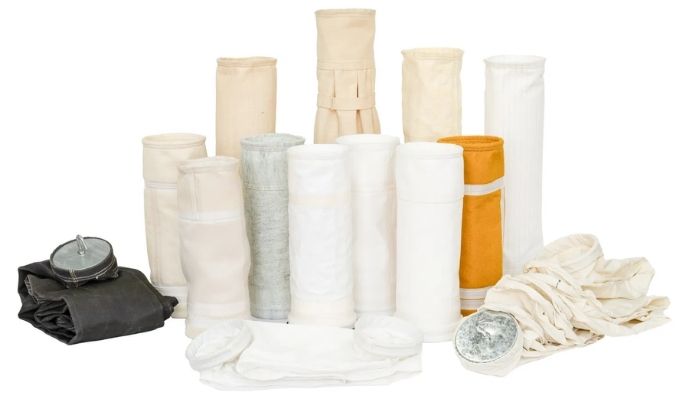
This requires a high-strength base fabric with good resilience and folding resistance. Strong needle felts such as polyester and PPS are often used and laminated to minimize dust embedment.

You need to match the cylindrical bag, which can provide a more uniform pressure distribution and reduce uneven dust cleaning.

You can make the bag mouth have a strong seal by equipping it with an elastic tension ring.

Pulse cleaning systems usually require a high grammage of the filter bag, preferably above 550g/m², which usually lasts for 3-5 years, in contrast to filter materials below 550g/m² which may deteriorate prematurely in response to the impact of the reverse airflow, with a service life of 1-2 years (the exact service life depends on the operating conditions).

Other Requirements

You must configure the compressed air system, pulse valve, and blowing tube to be high-strength to prevent deformation of the skeleton.

There should be an accurate control system here, which makes the precise blowing timing and blowing pressure realized. 

Shaking or Tapping Cleaning

Requirements for Filter Bags 

The way requires high abrasion resistance and structural stability of the filter bag. If you are using this system, then you need filter elements with good toughness and tensile resistance.

It is sufficient to use filter materials with a simpler structure and lower cost under normal working conditions, such as polyester needle felt.

Filter bags are constructed as flat bags or round bags with bag cage to ensure that they do not deform when subjected to stress.

The sewing of the filter bag should be firm and wear-resistant, especially at the position in contact with the hanging parts and neighboring parts. 

Other Requirements

First of all, you must configure a complete range of mechanical vibration devices, such as eccentric wheels and vibrating rods.

The overall structure must be stable to withstand long-term mechanical vibration, especially the filter bag suspension system, which needs strong stability.

Reverse Air Cleaning

Requirements for Filter Bags

This way requires high flexibility and excellent fatigue resistance. If you use this system, then you need the filter material with good flexibility, not easy to break.

Commonly used in high temperature environments, so often use good flexibility or high temperature resistant filter media, such as aramid, PPS, and glass fiber.

It is usually equipped with a long filter bag, which has good structural stability, suitable for a large-scale blowback cleaning system.

Other Requirements

The system requires an independent blowback fan and a large space.

Conclusion

We know that the system is called a system, that is because it is the parts of the precise convergence together, common operation, so as to achieve the effect we need, so we also need to understand the whole.

As a part of the dust collector system, the appropriate way of cleaning is of high importance to the filtration efficiency, service life, and production safety. Everyone concerned should not ignore it.

Different cleaning methods have their own unique cleaning mechanism. When we choose the cleaning method, we usually consider the dust characteristics, operating conditions, and system continuity requirements, and then match the appropriate cleaning method.

After the selection, it is also important to understand and meet the different requirements of the dust collector structure and core components under various cleaning methods to achieve the best filtration effect.

This is exactly what we always do when confirming filtration solutions with our customers. We only consider the system and never evaluate it individually to ensure that we know the right choice for the customer’s needs.

FAQ

  1. How can I cope with the loss of filter bag due to pulse cleaning?

Regularly check the stability of the compressed air.

Set the blowing pressure, blowing time, and interval appropriately.

Ensure that the position of the blowing pipe is appropriate, so that the airflow is evenly distributed to avoid localized excessive impact.

Choose the filter material with good fatigue resistance and resilience.

  1. How to ensure the effect of cleaning while extending the life of the filter bag?

The key lies in three points: a stable air source, reasonable clearing parameter settings, and the selection of filter bags or cartridges suitable for the clearing method. Dust removal is not more frequent the better, but “just clean”.

  1. Is the stronger the cleaning method, the better the cleaning efficiency?

Not necessarily. The cleaning intensity needs to match the size and adhesion of the dust particles. Too strong cleaning may accelerate the fatigue of the filter material, but shorten the service life. The right type of dust cleaning can effectively clean the dust and protect the filter element at the same time.

  1. When should I choose reverse air cleaning?

When the system size is large, the operating conditions are stable, and the requirements for the life of the filter bag are high, the blowback air cleaning is a more suitable choice. It is commonly used in large baghouse and high-temperature flue gas treatment scenarios.

  1. What is the difference between bag filter and cartridge filter in the choice of cleaning method?

Filter cartridges have a compact structure and large filtration area, and rely more on efficient pulse blowing ash cleaning; while filter bags are more flexible in structure and length, and can be adapted to a variety of ash cleaning methods, such as pulse, blowback, etc., but need to choose the appropriate filter material according to the ash cleaning strength.


tool by Update cookies preferences
Scroll to Top