Introduction
Filter bag clogging and the need for frequent maintenance are persistent problems that hinder production and the efficient operation of dust collection equipment.
This is especially obvious when dealing with fine dust particles. The main reason is that traditional needle-punched felt filter bags are prone to dust embedding, which further leads to increased energy consumption and high maintenance costs.
PTFE membrane dust collection filter bags are designed to address these industry pain points. This article will systematically introduce the definition, working principle, and core advantages of PTFE membrane filter bags.
What are PTFE Membrane Filter Bags?
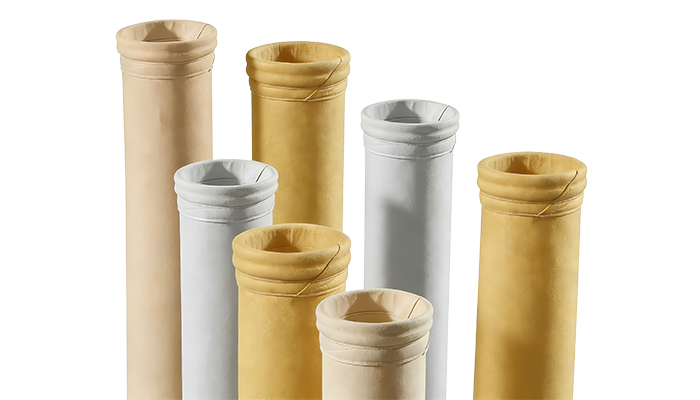
PTFE Membrane Filter Bags are dust filter bags made by coating a layer of PTFE membrane onto the surface of traditional filter media. This structure gives it higher filtration efficiency and a lower risk of clogging, which can meet filtration needs under certain special conditions.
Working Principle of PTFE Membrane Filter Bags
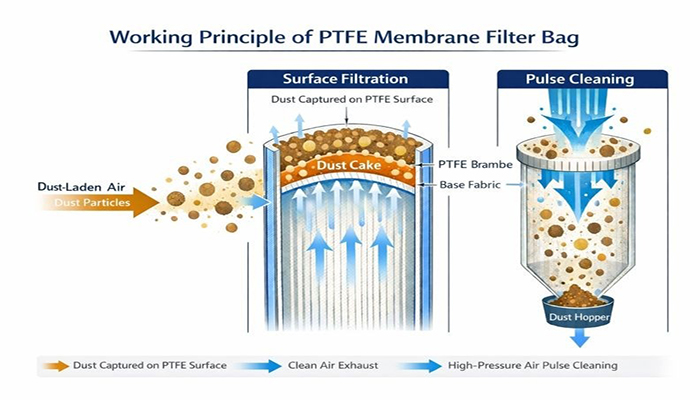
PTFE Membrane Filter Bags achieve high-efficiency, low-resistance, and low-emission dust removal through a systematic process of ‘surface filtration + dust layer enhanced filtration + pulse jet cleaning.’
Filtration Principle
When dusty gas passing through the filter bag is efficiently captured on the PTFE membrane surface.
The dust remaining on the surface gradually accumulates to form a dust cake, further improving filtration efficiency.
Common Pulse Jet Cleaning Method
A pulse jet cleaning system is usually used for this application to ensure effective dust removal.
The system injects high-pressure air into the filter bag interior, causing the entire dust layer to detach and the dust falls into the hopper.Then your filter bag can restore to a good, low-resistance operating state.
Tips of PTFE Membrane Filter Bags
Filtedge would like to share some practical experience with you.
Pre-coating Treatment
Although there is a general industry understanding that PTFE membranes do not require pre-coating treatment, we will further analyze the operating conditions for customers purchasing this type of filter bag and advise them on whether pre-coating treatment is necessary.
In cases of high viscosity, condensation risk, or special emission control requirements, you may consider pre-coating treatment to help protect the filter bags.
Temperature Resistance
PTFE membrane filter bags are not equivalent to 100% PTFE filter bags, and you need to be cautious when selecting them for high-temperature applications.
Membrane filter bags have a composite structure. Although the PTFE membrane has excellent high-temperature resistance, the temperature resistance is determined by the base fabric material, not the PTFE membrane itself. Therefore, the actual long-term operating temperature should consider the type of base fabric, such as: Polyester (≤130–150℃), PPS (≤190℃), and fiberglass (≤240℃).
Pros of PTFE Membrane Filter Bags
High-Efficiency and Stable Filtration
High-Efficiency Filtration
High-quality PTFE membranes feature uniform and tiny pore sizes, effectively blocking fine dust particles and easily achieving low emission requirements (such as <10 mg/Nm³).
Long-Term Stable Filtration
High-quality membrane filtration means high initial filtration efficiency, and also means less dust adhesion and more thorough cleaning, maintaining stable filtration performance over the long term.
High Corrosion Resistance
PTFE membranes have high resistance to most acids and bases. Therefore, in practical use, they can effectively prevent corrosive media from directly contacting the base fabric, improving the overall corrosion resistance of the filter bag.
However, this isolation cannot guarantee 100% efficiency. The base fabric may still be affected by some high-concentration, highly corrosive gases.
Therefore, in some harsh working conditions, such as highly corrosive environments, we recommend that you consult with a reliable supplier to evaluate whether a full PTFE filter bag should be selected.
Less Prone to Clogging
With a surface filtration mechanism,dust particles do not penetrate into the internal fibers like conventional needle-punched felts.
PTFE has strong chemical stability, preventing surface agglomeration and blockage caused by chemical reactions.
PTFE Membrane has good hydrophobic and oleophobic properties, making them less prone to clogging in humid working conditions.
These three points make PTFE Membrane Filter Bags less prone to clogging, solving the problem of frequent maintenance.
However, choosing PTFE membrane filter bags is not equal to less prone to clogging.
The key to truly solving the problem lies in using high-quality PTFE membrane filter bags.
When Do PTFE Membrane Filter Bags Deliver Real Benefits?
It does have many advantages, but the key to performing effectively and solving operational problems is choosing high-quality PTFE membrane filter bags,which depends on sophisticated manufacturing processes, mature membrane coating technology, and strict quality control.
Therefore, when making selection, you first need to carefully distinguish the quality of filter bags. Additionally, price factors should also be considered to ensure cost-effectiveness and achieve an ideal return on investment.
High-quality PTFE Membrane Filter Bags require you to:
Strictly control the quality of the PTFE membrane: ensuring uniform coating, absence of pinholes, and no localized thickening. Insist on using filter materials with uniform and small pore sizes to effectively intercept fine dust particles, easily meeting ultra-low emission requirements (e.g., <5 mg/Nm³).
Observe and confirm that a suitable base fabric structure has been selected and that proper pre-treatment of the base fabric has been performed, such as singeing, calendering, and heat setting, to reduce fiber fuzz and prevent dust from embedding.
Check that the bond between the membrane and the base fabric is strong, and strictly control the finished product’s air permeability.Test the air permeability and initial resistance of each batch to avoid clogging caused by “inherent high resistance.”
The cost analysis of PTFE coated filter bags
These filter bags may sometimes seem more expensive due to their higher unit price. However, the high-quality filter bags offer a more favorable overall cost of ownership.
Longer Service Life
High-quality PTFE membrane filter bags are less prone to clogging under normal operating conditions and have a service life of 6-8 years, which is twice that of ordinary needle-punched felt filter bags.
Lower Energy Consumption
Typically, under the same emission standards, the system energy consumption of high-quality PTFE membrane filter bags is reduced by approximately 10-20%.
Under the same operating conditions, the energy consumption of ordinary filter bag systems may be 15-30% higher than that of PTFE membrane filter bags.
Conclusion
During the long-term operation of bag filter systems, filter bag clogging can lead to a series of problems, such as increased energy consumption, decreased filtration efficiency, and even the risk of production interruptions.
To address this challenge, Filtedge uses advanced PTFE membrane technology to manufacture filter bags, ensuring excellent bonding strength and a uniform microporous structure between the PTFE membrane and the base fabric. This enhances the filter bag’s anti-clogging capabilities and service life, extending the filter bag replacement cycle and reducing downtime for maintenance. In some demanding operating conditions, annual maintenance costs can be reduced by approximately 15-30%.
In practical applications, different operating conditions require different filter bag structures and performance characteristics. Filtedge offers flexible customized solutions in the field of PTFE membrane filter bags, committed to providing stable and reliable filtration solutions for various industrial dust removal systems.
FAQ
- What are the applications of PTFE Membrane Filter Bags?
Waste incineration plants, steel plants, chemical kilns, cement plants, pharmaceutical industry.
- Under which operating conditions are PTFE membrane dust filter bags more recommended?
Although PTFE membrane filter bags offer excellent filtration efficiency and chemical resistance, they are not suitable for certain applications due to specific dust types or operating conditions.
- Applications with high oil or hydrocarbon content
These substances easily adhere to the PTFE membrane surface and clog the pores, leading to a rapid increase in pressure and filter bag blockage.
- High-abrasion dust applications
PTFE membrane filter bags are not suitable for high-velocity or highly abrasive dust environments, such as metal dust, quartz dust, and other high-hardness particulate matter.
Under these conditions, continuous high-speed particle impact accelerates membrane wear and shortens the filter bag’s lifespan.
- Long-term high-humidity operating conditions
This can lead to: dust caking and difficulty in cleaning.
- What is the most easily overlooked factor when selecting PTFE coated filter bags?
The compatibility of the base fabric material with the operating conditions.
The PTFE coating is only the filtration layer; the base fabric truly determines the filter bag’s temperature resistance, mechanical fatigue resistance, and overall lifespan. If the base fabric is improperly selected, premature aging or damage may occur even with a PTFE coating.