
Introduction
If you’ve seen enough air filters, it’s easy to see that some are simple flat shapes, while others resemble neatly folded “accordions”. So why are some air filters pleated? Is it just to look more sophisticated? In fact, it’s a very important engineering choice. This pleated construction directly affects the performance and applications of air filter.
Without a clear understanding of this, it can be difficult to select the right air filter based on actual needs. If you choose an inappropriate filter, it may lead to insufficient filtration efficiency, substandard air quality, increased system load, and even unnecessary extra expenses.
This blog will compare pleated air filters and non-pleated air filters in terms of structural design, filtration efficiency, airflow and resistance, and cost to help you understand the differences.
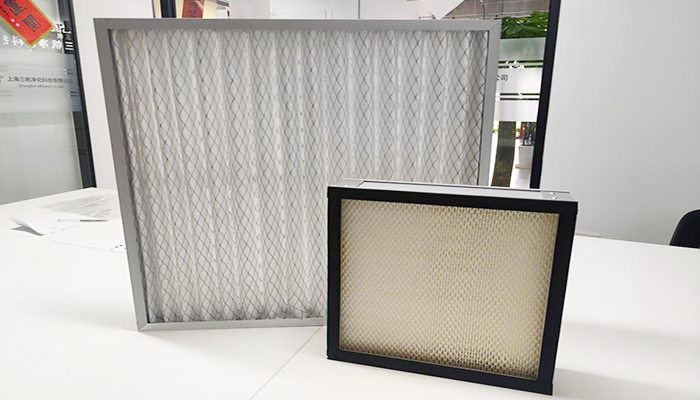
What Are Pleated Air Filters and Non-Pleated Air Filters?
Both can use glass fibers and synthetic fibers as filtration materials, but the different structure of filter media give them different properties to meet different air filtration needs.
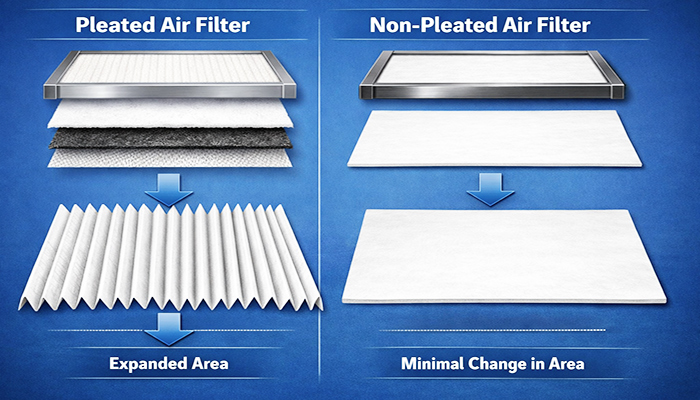
Pleated Air Filters
Pleated Air Filters use filter media with a large number of pleats to provide a larger filtration area.Pleated air filters provide a larger effective filtration area for the same filtration area by folding the filter media. Its ability to capture fine particulate matter often depends on the filter media selected, the MERV rating, the filtration wind speed, and the overall structure of the filter.
Non-Pleated Air Filters
Non-Pleated Air Filters have a flat filter media and a single layer or a small number of stacked layers of filter media, which means a small filtration area.This type of filter is mainly used for coarse particle filtration.
Comparison of Pleated Air Filters and Non-Pleated Air Filters
Filtration Efficiency: Pleated vs Non-Pleated Air Filters
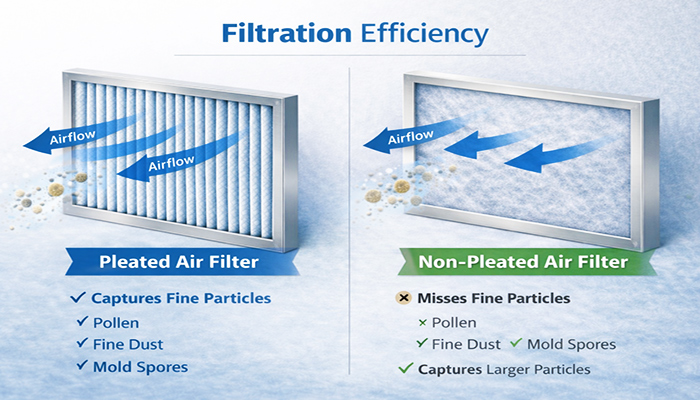
Filtration efficiency is one of the most important factors when choosing an air filter. The structural design of pleated and non-pleated filters leads to noticeable differences in how effectively they capture airborne particles.
With the same ventilation surface size, pleated air filters typically have a larger limited filter media area than flat filters. When the filter media, pleat spacing, and airflow are reasonably matched, their dust capacity is higher, enabling higher filtration efficiency.
Thus, the pleated models are able to meet the stringent filtration needs of homes, businesses, hospitals and other locations.
In contrast, the filter material of non-pleated air filter make it mainly rely on interception and inertia effect for filtration, and the filtration efficiency is slightly inferior. It is suitable for use in industrial plants and storage places. At the same time, it is also appropriate to choose it as a primary filter to protect the HVAC system.
| Feature | Pleated Air Filters | Non-Pleated Air Filters |
| Filtration Area | Large | Small |
| Media Arrangement | Folded Media with A Larger Effective Area | Flat or Pad-style Media with A Smaller Effective Area |
| Airflow Path | Long | Short |
| Fine-Particle Capture | Depends Mainly on Media Performance and Tested Efficiency, not Pleating Alone | Depends Mainly on Media Performance and Tested Efficiency, not Pleating Alone |
MERV Rating and Energy Consumption: Pleated vs Non-Pleated Air Filters
When conditions such as air filter size, thickness, filter media area, and air volume are the same, the pressure may increase at higher MERV ratings. However, energy consumption cannot be determined solely by the MERV rating.
Pleated air filters and non-Pleated air filters have different MERV ranges.
Pleated and non-pleated air filters have different MERV ratings. The actual filtration rating needs to be confirmed by real test data and cannot be determined by structural type. Common ratings for pleated HVAC air filters are MERV 7 to MERV 13. Primary air filters are typically MERV 4 to MERV 7 and are primarily used for coarse filtration.
You can make a decision based on your actual filtration needs. It is not necessary to blindly pursue a high MERV rating, as it may bring unnecessary energy consumption and cost in the meantime.
For example, in a warehouse ventilation system, if you only need to prevent dust and large particles from entering the equipment, using non-pleated models with a MERV 5-6 is sufficient, instead of using pleated air filters with a high MERV rating, which saves money and maintains the efficiency of the fan.
| Application | Recommend MERV Rating | Reason |
| Industrial Pre-Filtration | 6–8 | Equipment protection |
| Residential Homes | 8–11 | Remove dust and pollen |
| Commercial Offices | 11–13 | Improve air quality and reduce allergens |
| Medical Facilities | 13+ | Control microorganisms and fine particles |
Replacement Frequency: Pleated vs Non-Pleated Air Filters
The thickness and construction of the filter media gives pleated air filters a higher dust holding capacity and longer replacement intervals, typically 60 to 90 days. Thicker pleated air filters (e.g., 4-5 inches) may actually last 3-6 months or more.
A 60-90 day replacement is common in everyday home HVAC systems.
In environments with high dust levels, pets, allergies, or around-the-clock operation, a 30-60 day replacement is recommended to ensure efficiency.
Additionally, some are labeled for 90 days, but should be replaced sooner if dust buildup is visible or air flow is significantly reduced.
Non-pleated air filters have a relatively low dust holding capacity and should generally be changed every 30 days.
Regardless of the type of filter, regular inspections are recommended. Even if the environment is not too dirty, frequent inspections are necessary to help extend the service life. Since the rate of dust accumulation is strongly influenced by changes in the environment, regular inspections can detect clogging in time and prevent the filter media from wearing out too quickly.
Price Difference: Pleated vs Non-Pleated Air Filters
Understanding the reasons and value of the price difference will help you make a more rational choice.
The material usage and manufacturing complexity are major factors in the price difference between these two filters.
Pleated air filters require more material and demand a high degree of precision in the folding of the filter media, a strong pleat hold, and a strong frame seal, all of which add to the cost.
Overall, although this type of filter cost more, the value of the pleated design is clear: higher filtration efficiency, more dust holding capacity, longer service life, and less frequent replacement and maintenance. So the price difference doesn’t directly affect the actual choice.
If you have a limited budget and only use air filters for basic dust control or primary filtration, non-pleated air filters are the economical choice.
However, if your premises have high air quality requirements, or if you want to reduce the frequency of replacement and maintenance costs, pleated models often offer a better overall price/performance ratio in the long term, and are sometimes even more economical than non-pleated air filters.
Space Requirements: Pleated vs Non-Pleated Air Filters
This difference of these two air filters are less mentioned because it is not significant.
Non-Pleated air filters are typically about 1 inch thick and are suitable for systems with limited installation space;
Pleated air filters are slightly thicker, 1-, 2- and 4-inch, but the folded design significantly increases the effective filtration area, allowing existing filter racks and HVAC systems to be installed in the same system when they are compatible
So for most standard HVAC systems, both are a good match and space is not a major constraint.
However, in older or smaller installations where space is at a premium, it is best to check the installation depth in advance.
Airflow and Pressure Drop: Pleated vs Non-Pleated Air Filters
Airflow determines the efficiency of air exchange, Pressure Drop is related to the system energy consumption and fan load. Both of them directly affect the operation efficiency and filtration effect of the air filter.
Equipped with pleated air filters, the air can pass through more evenly, the air velocity is more reasonable, thus reducing the pressure drop, even if the dust accumulates, the filter can also maintain a stable airflow under moderate power.
In contrast, non pleated air filters have flat filter media and limited filter area.when the flow is larger, the airflow is concentrated, which can make pressure drop increase rapidly.In addition, as particles accumulate, pressure drop in non-pleated filters usually rises faster.
So,if the air filter is used in a continuous, high volume airflow location, such as HVAC commercial systems, medical facilities or industrial high airflow scenarios, there will be a higher requirement for air flow stability and low pressure drop.At this time, pleated air filters is a more efficient and practical choice.
Non-pleated air filters are suitable for low airflow or primary filtration scenarios, and their simple construction makes them more economical in terms of cost and maintenance.
| Item | Pleated Air Filter | Non-Pleated Air Filter |
| Initial Pressure Drop | Moderate or relatively low | May be higher when media density is high |
| Airflow Resistance as Dust Loads Increase | Increases slowly, large dust holding capacity | Faster due to limited capacity |
| System Compatibility | Suitable for high airflow systems | Suitable for low airflow systems or as pre-filters |
Conclusion
Choosing the right type of air filter is an important step in ensuring clean air, stable system operation, and long-term cost control.
These two air filters each have their own advantages and application scenarios.
Pleated Air Filters have a longer service life and provide high efficiency filtration. It is suitable for commercial buildings, medical environments, and high-standard homes that require high air quality, high airflow, and long run times. At the same time, longer replacement intervals and lower maintenance frequency make it more cost-effective in long-term operation.
In contrast, Non-Pleated Filters are simpler and more cost effective, and are suitable for primary filtration or equipment protection. It is a practical and economical choice for industrial ventilation systems or applications with limited budgets.
Choosing a reliable supplier is the critical second step in making this choice a reality, guaranteeing product quality and ongoing service.
Filtedge always evaluates each customer’s air quality needs and system conditions and considers factors such as filtration efficiency, MERV ratings, pressure drop, service life, maintenance frequency, installation space and budget to determine the right filtration solution design and product selection. Thus, the concept of improving air comfort, saving long-term maintenance costs, and ensuring efficient and stable operation of the system becomes a reality.
FAQ
Q1. Pleated air filters and Non-Pleated air filters ,Which filter is better for allergy control?
Pleated filters are more effective at capturing pollen, dust mites, and allergy-inducing fine particles compared to non-pleated air filters, making them suitable for allergy control.
Q2. Why are pleated air filters more suitable for commercial HVAC systems?
Commercial HVAC systems require air filtration systems that handle large air volumes, provide stable airflow, have a long lifespan, and are easy to maintain.
Commercial environments (such as office buildings, shopping malls, schools, and hospitals) typically have higher requirements for indoor air quality, needing effective protection against dust, pollen, mold, and other fine airborne particles. This usually requires a MERV rating of 8–13, and in certain situations, even higher ratings. This is something non-pleated air filters cannot achieve.
In contrast, pleated air filters, with their pleated structure, multi-layered high-density filter media, large dust capacity, long lifespan, and support for MERV ratings 8–13, meet commercial air cleanliness requirements. Furthermore, the well-designed pleated structure helps to distribute airflow evenly, maintaining a stable airflow while ensuring filtration efficiency.
Therefore, pleated air filters can more comprehensively meet the air filtration needs of commercial HVAC systems.
Q3. Are the pressure drop of pleated air filters always greater?
Not necessarily. The factors that truly affect the pressure drop include filter media density, MERV rating, air velocity, and installation seal.
Although pleated air filters have more layers, their pleated structure significantly increases the effective filtration area, resulting in a more uniform airflow distribution. Therefore, with proper design, the initial pressure drop of pleated air filters may be comparable to, or even lower than, that of high-density non-pleated air filters.