Introduction:
Incorrect selection of air filters can lead to inadequate filtration efficiency, higher energy consumption, more frequent replacement, and system operation risks. This article analyzes air filter types and applications from an engineering point of view, which will help engineers and purchasers quickly understand the differences between different air filters and make the right selection decisions.
What is an Air Filter?
As a key component of air filtration, an air filter filters out airborne particles, fine bacteria, or pollutants such as VOCs through physical interception and adsorption. It plays a vital role in making the air in the home cleaner, providing a clean and stable environment for industrial production, pharmaceutical, medical, commercial and other areas, and protecting the stable operation of production equipment.
Types of Air Filters
About air filters are rich and varied, it can be categorized from different dimensions, generally through the filtration efficiency, filtration media, shape and structure of the classification, the following I will be based on these different dimensions, for your detailed introduction.
By Efficiency (MERV, HEPA, ULPA)
The filtration efficiency is directly related to the ability to remove small particles, mainly according to the size of particles, to choose different efficiency filters, so that its filtration effect is optimized.
Primary air filter as a pre-filter, corresponding to the filtration efficiency: European standard EN779 G1-G4, American standard ASHRAE52.2 MERV1-MERV8 level, mainly filtering large particles of dust >5-10 microns, such as dust, cotton wool, etc., mainly to protect the medium and high efficiency filters and HVAC equipment, to prevent the back end of the medium and high efficiency filters from being clogged too quickly, which will affect the efficiency and delay the service life of the filters. and delay the service life.
Medium-efficiency air filters, with filtration efficiency corresponding to the F5-F9 class of the European standard EN779 and the MERV9-MERV14 class of the American standard ASHRAE 52.2, are the mainstay of commercial ventilation equipment, which mainly filters medium particles of 1-10 micrometers, such as mold spores, bacteria, dust, and so on. It is widely used in commercial ventilation systems, industrial ventilation systems, and pre-filters in hospitals.
Sub-high-efficiency air filters, corresponding to the filtration level of European standard EN779 F7-F9, which is between medium-efficiency air filters and high-efficiency air filters, generally filtering small particles <1 micron, and is mainly used in places with high cleanliness of the air but do not need HEPA level, such as hospitals, laboratories, the food industry, electronic factories, high-end residential and HVAC systems, and so on.
The corresponding filtration level of HEPA filter is U.S. DOE standard ≥99.97% @0.3 μm, EN 1822 H13/H14 standard, which has a higher filtration level, and mainly removes virus droplets, smoke and dust in the air, which is applied in the ventilation system of environmental operating rooms, isolation wards, semiconductors, pharmaceuticals, and high-end household.
Ultra-high-efficiency air filter corresponds to the filtration level EN 1822/ISO 29463 U15-U16, which is higher than the HEAP filtration level, and can remove smaller particles, and is mainly used in industries with more stringent air requirements, such as chip manufacturing, top laboratories, and the nuclear industry.
By Filter Media
The filter material of the air filter is the key factor to determine the efficiency of air filtration, different materials have different filtration efficiency and principle, I will explain each material specifically, you can choose the suitable filter material according to your application environment.
Glass fiber
Glass fiber is made of borosilicate glass drawn into fibers, the diameter of the fibers (generally 1-5um) is extremely fine, the fibers are interlaced with each other to form a non-woven structure of the media, mainly used for deep filtration. It is a little bit of filtration efficiency is extremely high (especially more than less than 0.3 micron particles) high temperature resistance, the disadvantage is very brittle, fragile. It is mostly used as raw material for high efficiency and ultra-high efficiency air filters.
Synthetic Fibers
Synthetic fibers are mainly nonwoven fabrics made of polypropylene PP, polyester PET and multilayer composite materials, which are mainly used for surface and deep filtration. Its main advantages are low pressure drop, low cost, impact resistance, but not as high temperature resistant as glass fiber. It is mostly used as raw material for middle and lower efficiency air filters.
Activated Carbon
Activated carbon is generally made of coconut shell, coal, wood as raw materials, high temperature activation, the surface of the formation of a lot of pore size, with a larger specific surface area. It mainly removes VOCs and odorous gaseous pollutants. Activated carbon is mostly used in HEPA composite, which is mostly used in household air purifiers, spraying workshops, laboratories, etc. to improve the odor environment.
Metal mesh/washable filter
Metal mesh air filters are mainly made of aluminum, stainless steel, galvanized steel wire, mostly made of primary air filters, belonging to the surface of the large particles filtration. Generally used in the environment of large particles, hair and cotton wool, and heavy oil pollution. Advantages are repeatable cleaning, long life, low resistance, disadvantages can only be used as a primary filtration.
By Form/Structure
The structure of the air filter will affect its volume, dust holding capacity, installation method, and choose the appropriate structure according to your use scenario, which also has a great impact on the air filtration efficiency.
Panel Air Filter
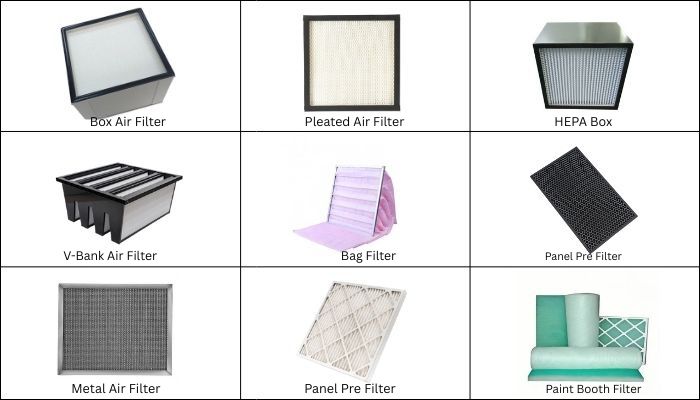
Panel air filter is a flat or simple pleated filter media (including keel filters, mesh-covered cotton filters) placed in a square or rectangular frame. Its obvious features are space-saving, good replacement, small filtering area, commonly used in middle and lower efficiency air filters.
Bag Air Filter
Bag Air Filter is made of glass fiber or synthetic fiber sewn or ultrasonically welded into several rectangular bags, which are fixed on a frame with card strips to keep the spacing of each bag to prevent collision. It has a large filter area, high dust holding capacity and relatively low resistance. This construction is typically used for medium or sub-high efficiency Bag Air Filter and is the most commonly used bag type in HVAC systems.
Pleated Air Filter
Pleated air filter is to pleat the filter media, there are deep pleats and shallow pleats, the more pleats, the deeper the pleats, the larger the filtration area, and the greater the resistance, pleated air filter is the optimal choice when the space is limited and the filtration area has to be increased. Middle and high efficiency filters have this structure, and the application range is also the widest.
Cartridge Air Filter
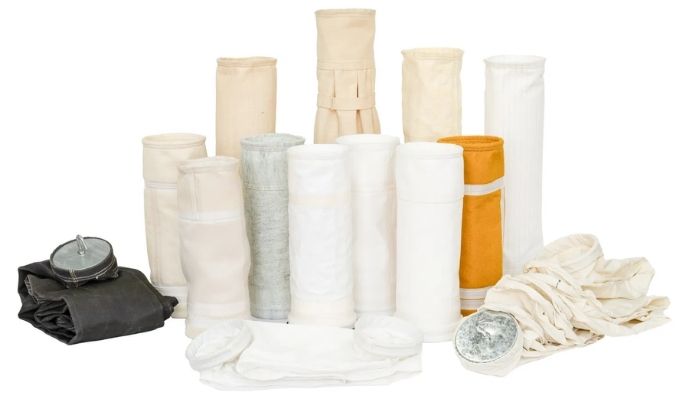
The cartridge air filter is usually the filter material pleated and wound into a cylindrical shape, with a skeleton in the center and at both ends to prevent the filter material from collapsing to ensure its filtration efficiency. It will be divided into different sizes according to the length and diameter. The advantage of air filter cartridges is that they have a large filtering area and good pressure-carrying capacity, and are mostly used in industrial dust collectors, air purifiers, and air intakes of machines.
Box Air Filter
Box air filter has a strong outer frame, usually in square, rectangular box or w/v shape, with pleated filter media inside. Its structure is more stable, suitable for large air volume and high wind speed of the industrial environment, box-type is mostly used for high-efficiency air filters.
Electrostatic air filters
Electrostatic filters use electrostatically charged filter media or a high electric charge to generate an electric field to utilize the attraction of static electricity to capture airborne particles. Its distinctive feature is that it achieves high filtration efficiency at a lower resistance. Mostly used in air purifiers, automotive air filters, or commercial ventilation systems, hospitals, pharmaceutical industry, etc.
Activated Carbon Air Filter
Activated Carbon Filter is made of activated carbon particles, activated carbon fibers, and honeycomb activated carbon, which mainly removes gaseous pollutants, such as VOCs.
Composite Air Filter
Composite Air Filter is a composite air filter that is made by placing a number of different grades of filter media into an outer frame to form a multi-effective filter. Composite air filter: Composite air filter, mainly several different levels of filter media into a frame to form a multi-effect filter, common types, such as primary + HEPA + activated carbon, this type of air filters are mostly used in household.
Photocatalyst UV sterilizing air filter
Photocatalyst UV sterilizing air filter, mainly using specific wavelengths of direct irradiation, so that bacteria and viruses lose their activity, so as to play the role of sterilization and disinfection, its main raw material is titanium dioxide, but need to rely on ultraviolet radiation.
Air Filter Applications
Air filters are widely used in household, industry, commerce, transportation and other fields to maintain fresh and clean air for people and ensure safe and stable operation of industrial production environment. The following are the applications of air filters in different environments.
Residential HVAC
Household air filtration mainly needs to remove dust, lint, hair, odor, bacteria and viruses in the air. Mainly used in the central air conditioning air return or air handling units, as well as air purifiers, mainly used in primary air filters, HEPA filters, activated carbon air filters, or photocatalyst filters and so on.
Commercial Buildings
Industrial production is covered by the widest range of industries, including industries, (cement, wood processing, chemicals, ores, paint booths, industrial plants, pharmaceuticals, animal husbandry, food and beverage processing, clean room, electronics manufacturing, nuclear industry,) but also with air filters are more places, usually we become industrial air filters, which mainly removes dust, oil mist, chemical fumes, smoke, industrial exhaust gas, microbial contamination, etc., in the production environment, mainly used in the production of dust, oil mist, chemical fumes, smoke, industrial exhaust gas, microbial contamination. It mainly removes dust, oil mist, chemical fumes, smoke, dust, industrial exhaust, microbial contamination, etc. from the production environment, aiming at providing a stable production environment and protecting the normal operation of machines and equipment. Depending on the working conditions, middle and high efficiency air filters are generally used together, like clean room, pharmaceuticals will use high efficiency and ultra-high efficiency, HEPA (H13-H14) or ULPA (U15-U17).
Industrial & Cleanroom Applications
Commercial HVAC systems, ranging from office buildings, shopping malls, healthcare, airports, etc., are designed to provide healthy indoor environments, meet ventilation requirements, and protect HVAC equipment. Commercial HVAC systems usually use a combination of multi-stage filtration, with primary filtration using primary air filters (G1-G4), and secondary filtration using intermediate- and high-efficiency air filters (F5-F9, H10-H13), taking into account the filtration efficiency of the filters, the resistance, and the dust holding capacity.
Transportation Systems
Transportation industry, including subway, train, car air conditioning, airplanes, engine air intake, etc., mainly to stop airborne dust, pollen, bacteria, dust, gravel, etc., mainly for the respiratory environment and protection of the engine, the filters are mostly pleated plate or cartridge air filters.
Filter Frames/Edges
Air filtration materials are made of various materials, usually including aluminum frames, stainless steel, galvanized steel, plastic, paper frames, composite frames, etc. Different materials of the frames have their unique characteristics, and when choosing, according to your application environment, select the appropriate frame with the filter material, which will make the filtration performance of the air filters to be played to the best.
Aluminum frame
Aluminum frames are used in middle and junior high efficiency air filters, and it is a widely used material, which is used in middle and junior high efficiency air filters. Its main features are corrosion resistance, humidity resistance, light weight, and it can adapt well to high humidity environment because of its light structure, and it is also very easy to dismantle and install.
Stainless steel / galvanized steel frames
Stainless steel / galvanized steel frames have very similar characteristics, such as high temperature resistance, corrosion resistance, extremely robust structure, generally applicable to the use of harsh working conditions, can withstand high loads and pressure differentials, at high temperatures, high humidity and chemical corrosive places, can be a continuous and stable operation.
Plastic frames
Plastic frames are also called PP frames, it is because the frame is lightweight, humidity, corrosion resistance, the price is low. Commonly used in environments where there is a budget cost for corrosive environments, plastic frames are the preferred choice. This material is mostly used in home or commercial heating and air conditioning and is a more economical choice.
Paper frames
Paper frames are made of compressed cardboard, strong in weight, and are generally used for one-time use. Since it is inexpensive, it is mostly used in temporary locations or environments where filter replacement is more frequent. Primary effect filters generally use paper frames.
Composite
composite frame is made of high-performance materials, with good sealing and impact resistance, it can well prevent leakage, will also be more used for high-efficiency air filters, composite materials corrosion resistance, high temperature resistance can have a certain degree of resistance to mechanical impact, suitable for high requirements of the environment.
How Air Filters Work
The principle of removing pollutants by air filters is not a single mechanism, but the result of a variety of physical interactions. Sometimes chemical reactions or electrostatic effects are involved, and the synergy of these mechanisms depends on the characteristics of the pollutant, especially the size of the particles and the conditions of the air flow.
Physical filtration mechanism:
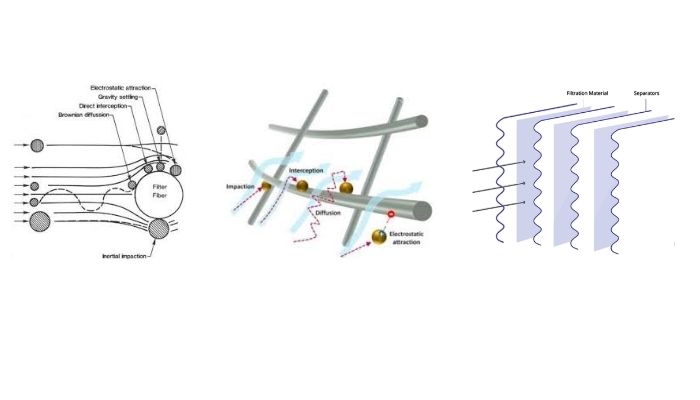
retention and interception is when the airflow with air particles flow through the filter media, particles larger than the pore size of the filter media fibers, will be directly intercepted by the filter media, stay on the surface of the filter media, mainly for the range of 0.1 micron-1 micron particulate matter interception, at the same time, the larger the particles the higher the efficiency of interception.
The principle of collision or inertia is that when the air flow with particles flow to the filter media, the volume of slightly larger particles can not be as flexible as the air flow to change direction, because of its inertia particles will be directly impacted on the surface of the filter media to be captured, this principle is usually more effective for particles > 1 micron, the faster the air flow, the larger the particles, the more pronounced the effect of inertia.
Diffusion is usually less than 0.1 micron particles, due to the small volume and mass, with the flow of air or air molecules collision, the shape of the Z-shaped irregular movement, we call it “Brownian motion”, when they collide with the filter media, it will be captured. When the airflow is smaller, the Brownian motion is more adequate, the better the efficiency of diffusion capture.
Electrostatic adsorption
The principle of electrostatic adsorption is mainly divided into two kinds, one is the electret filter material, directly on the filter fibers with electrostatic charge, they will actively adsorb the charged particles in the air, and even polarize the uncharged particles, which can achieve a relatively high filtration efficiency under low resistance. The other is to utilize an electrostatic precipitator, where the airborne particles are charged with a point by a high-voltage electrical discharge, and then the particles are captured when the airflow passes over the oppositely-charged collection plate. Generally medium and high efficiency air filters will use electrostatic adsorption technology
Activated Carbon Adsorption Principle
Activated carbon is a special material activated by high temperature, the surface is full of pores, mainly to remove VOCs in gaseous pollutants, this material should be careful to avoid high-temperature environments, if the temperature rises, it will result in the release of adsorbed pollutants again, which is also called desorption.
Air Filter Efficiency and Performance
Understanding filter efficiency
Air filter filtration efficiency refers to the ability of the air filter to remove particles and pollutants, usually closely related to the size of the particles, the more particles are captured and removed under certain conditions, the higher the filtration efficiency. This is an important indicator of the efficiency of an air filter.
MERV Filter ratings
MERV in full English is Minimum Efficiency Reporting Value, which refers to the Minimum Efficiency Reporting Value. This is the rating standard used to measure the air filter, the value is from MERV1-MERV16, the higher the value, the higher the filtration efficiency.
How to Install an Air Filter

- First confirm the airflow direction indicated on the air filter frame, make sure the windward side of the filter is at the air inlet.
- Ensure that the filter frame and the mounting frame are tightly fitted, and that there are no air leakage or air intake problems.
- After the installation is completed, check the entire frame to see if there is any looseness or damage.
Choosing the Right Air Filter
According to the type of pollutants to choose, first of all you need to clarify what pollutants to be removed? For example, particles, gases, microorganisms. According to the article above different filter materials, choose the right material and grade for you.
According to the performance indicators to choose, air filters generally through the MERV and HEPA two indicators, the general choice of household MERV8-MERV13 commercial general choice of MREV11-MERV14 clean room selection of MERV14-MERV16. HEPA refers to the capture of particles larger than 0.3 micron efficiency of 99.97% of the filtration standards, usually used in the HEPA is a filtration standard with 99.97% efficiency in capturing particles larger than 0.3 micrometers and is usually used in clean rooms, hospitals, etc. HEPA is rated H13-H14.
Maintenance and Service Life of HEPA Filters
How to maintain a HEPA filter
The air filter should be inspected regularly, if there is clogging or airflow drop, the non-washable air filter should be replaced in time, and the washable air filter should be cleaned with a soft bristle brush or a low-pressure vacuum cleaner to clean the surface dust.
Replacement cycles and lifespan
The replacement cycle of air filters generally ranges from 3-12 months. For domestic use, it generally depends on the frequency of application and the quality of air, and the accumulation of dust. For industrial and commercial use, it depends on the differential pressure gauge. If the pressure drop increases significantly, it means that the air flow has decreased and needs to be replaced in time. Its life expectancy is also generally 6-12 months, and the factors that affect it include air pollution, selection level, air humidity, and the intensity of the fan’s use.
Final Conclusion
If your project involves HVAC, industrial production or clean environment, we recommend you to communicate with us during the selection stage. At Filtedge, we have more than 20 years of manufacturing experience and a lot of successful cases, which can help you to reduce the system risk and optimize the long term operation cost, and give you the support of mature, floor-to-ceiling filtration solutions.
FAQ: Air Filters Explained
- What Does MERV Mean On Air Filters?
MERV is used to measure the filtration efficiency of air filters on different sizes of particles, the value range is MERV1- MERV16, the higher the value, the better the filtration efficiency.
- What Does FPR Mean On Air Filters?
EPR is Filter Performance Rating, which represents the filtration performance of the filter, divided into 1-10 levels, similar to MERV, but it is more intuitive and easier to understand.
- Can You Wash Air Filters?
Air filters are divided into washable and non-washable types, washable can be cleaned with a soft brush, usually aluminum mesh, metal mesh. The non-washable ones can only be replaced.
- What Is The Best MERV Rating For Air Filters?
There is no such thing as the best filtration rating, it is the best filtration rating if you feel that you are using the right air filters for your environment and give full play to its filtration effect to meet the filtration requirements.
- Which Way Should Air Filters Face?
Air filters are labeled with arrows on their borders, and the arrows point to the direction of air flow.
- What Size Air Filter Do I Need?
The size of the air filter should be the same as the filter size of the air conditioner or duct unit. Check the labeling of the existing filter or the air conditioner’s manual.
- Do Air Filters Improve HVAC Efficiency?
Properly sized air filters protect the HVAC system and maintain airflow. However, a high MERV can increase resistance and decrease efficiency.